
You invest in a beautiful fragrance. You spray it before leaving home, expecting it to stay with you all day. Yet just a few hours later, the scent seems to have vanished.
Sound familiar?
The truth is, your perfume may not be the problem. More often than not, it’s how it’s applied, stored, or worn that affects its performance.
Even the finest fragrances can fade quickly if used incorrectly. Understanding a few simple habits can dramatically improve how long your perfume lasts and how beautifully it develops throughout the day.
In this guide, we’ll uncover 10 common perfume mistakes that reduce longevity and share expert tips to help you enjoy every spray to its fullest.
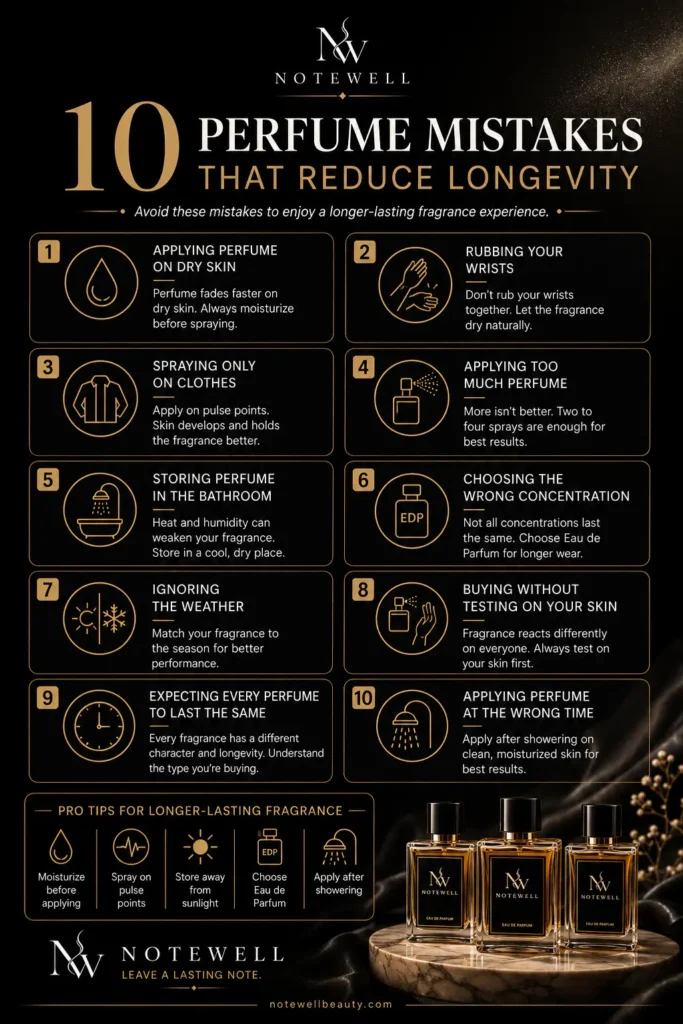
1. Applying Perfume on Dry Skin
One of the most common reasons perfume fades quickly is dry skin.
Fragrance molecules need moisture to cling to. When applied to dehydrated skin, they evaporate much faster, causing the scent to disappear sooner than expected.
What to Do Instead
Apply an unscented moisturizer or body lotion before spraying your perfume. Hydrated skin holds fragrance better, allowing it to develop naturally and last significantly longer.
A simple skincare step can make a noticeable difference in your perfume’s performance.
2. Rubbing Your Wrists Together
Many people instinctively rub their wrists together after applying perfume.
While it may seem harmless, this creates friction and heat, which can alter the fragrance’s delicate top notes and disrupt the way the scent evolves.
What to Do Instead
Spray your perfume onto your wrists or pulse points and let it dry naturally.
Allowing the fragrance to settle on its own preserves the intended scent profile created by the perfumer.
3. Spraying Only on Your Clothes
Clothing can hold fragrance for a long time, but relying only on fabric means missing the full experience of the perfume.
Fragrances are designed to interact with your skin’s natural warmth and chemistry, allowing the top, heart, and base notes to unfold beautifully over time.
What to Do Instead
Apply perfume primarily to your pulse points, such as:
- Neck
- Wrists
- Behind the ears
- Inner elbows
If appropriate for the fabric, you can lightly mist clothing from a safe distance, but skin should remain the primary application area.
4. Applying Too Much Perfume
When a fragrance fades quickly, many people assume they simply didn’t use enough.
In reality, overspraying rarely improves longevity. Instead, it can overwhelm both you and those around you.
Luxury fragrances are designed to be noticed subtly—not announced from across the room.
What to Do Instead
For most Eau de Parfum fragrances, two to four sprays are usually enough.
Focus on strategic placement rather than excessive application.
5. Storing Perfume in the Bathroom
Bathrooms may seem like a convenient place to keep perfume, but they expose fragrances to constant humidity and temperature changes.
Over time, these conditions can gradually affect the stability of the fragrance, altering both its scent and performance.
What to Do Instead
Store your perfume in a cool, dry place away from:
- Direct sunlight
- Heat
- Humidity
- Windowsills
A bedroom drawer or wardrobe shelf is often a better choice for preserving fragrance quality.
6. Choosing the Wrong Perfume Concentration
Not every fragrance is designed to last all day.
Many people unknowingly purchase lighter concentrations expecting the performance of a more concentrated perfume.
For example, Eau de Cologne and Eau de Toilette generally contain less fragrance oil than Eau de Parfum.
What to Do Instead
Choose the concentration that best matches your lifestyle.
If longevity is your priority, an Eau de Parfum (EDP) typically offers longer wear and a richer scent experience.
7. Ignoring the Weather
Temperature plays a major role in how perfume behaves.
Hot weather causes fragrances to evaporate more quickly, while cooler temperatures often allow richer scents to linger longer.
Applying a heavy oud fragrance on a humid summer afternoon—or an extremely light citrus scent during winter—may not deliver the experience you expect.
What to Do Instead
Match your fragrance to the season.
Summer: Citrus, aquatic, and fresh green fragrances.
Winter: Amber, vanilla, oud, sandalwood, and warm spicy notes.
Choosing season-appropriate fragrances helps them perform at their best.
8. Buying Without Testing on Your Skin
A perfume can smell incredible on a paper strip but completely different once it meets your skin.
That’s because everyone’s skin chemistry is unique, influencing how fragrance notes develop throughout the day.
What to Do Instead
Always test perfume on your skin.
Wear it for at least 30 minutes before making a decision. This gives you time to experience the fragrance from its bright opening notes to its lasting base.
9. Expecting Every Perfume to Last the Same
Not all fragrances are created for maximum longevity.
Fresh citrus, green, and aquatic scents naturally feel lighter and often fade sooner than richer compositions featuring amber, vanilla, woods, or oud.
This doesn’t mean one perfume is better than another—it simply reflects different fragrance styles.
What to Do Instead
Understand the character of the perfume you’re buying.
If long-lasting performance is important, choose fragrances with richer base notes and higher concentrations rather than expecting every scent to perform identically.
10. Applying Perfume at the Wrong Time
Many people spray perfume just before rushing out the door.
While this works, it doesn’t allow the fragrance enough time to settle into the skin.
What to Do Instead
Apply your perfume shortly after showering, when your skin is clean, warm, and slightly moisturized.
This creates the ideal surface for the fragrance to bond with your skin and develop naturally throughout the day.
Bonus Tips to Make Your Perfume Last Longer
If you want to get the most from every bottle, keep these professional habits in mind:
- Moisturize your skin before application.
- Spray perfume on pulse points rather than rubbing it in.
- Store fragrances in a cool, dry place.
- Rotate perfumes according to the season.
- Apply perfume to clean skin for the best performance.
- Avoid exposing your bottle to direct sunlight.
- Choose the right concentration for your needs.
- Reapply only when necessary—not out of habit.
Small changes in your routine can make a significant difference in how long your fragrance stays with you.
Final Thoughts
A long-lasting fragrance isn’t determined solely by the quality of the perfume—it’s also shaped by how you wear and care for it.
Avoiding these common mistakes can help your fragrance perform exactly as intended, allowing its carefully crafted notes to unfold beautifully from morning to evening.
At Notewell, we believe every fragrance should become part of your story. When applied thoughtfully and cared for properly, a well-crafted perfume doesn’t just smell beautiful—it leaves a lasting impression.
Because the finest fragrances aren’t measured by how loudly they announce themselves.
They’re remembered by how long they stay with you—and how they make people feel.
Notewell
Leave A Lasting Note.